
Pipe insulation - Arlington, TX
Pipe insulation
Insulation for steam, condensate and process piping. Send the pipe size, approximate length, operating temperature and photos; we review materials, jacketing, access and scheduling for your facility.
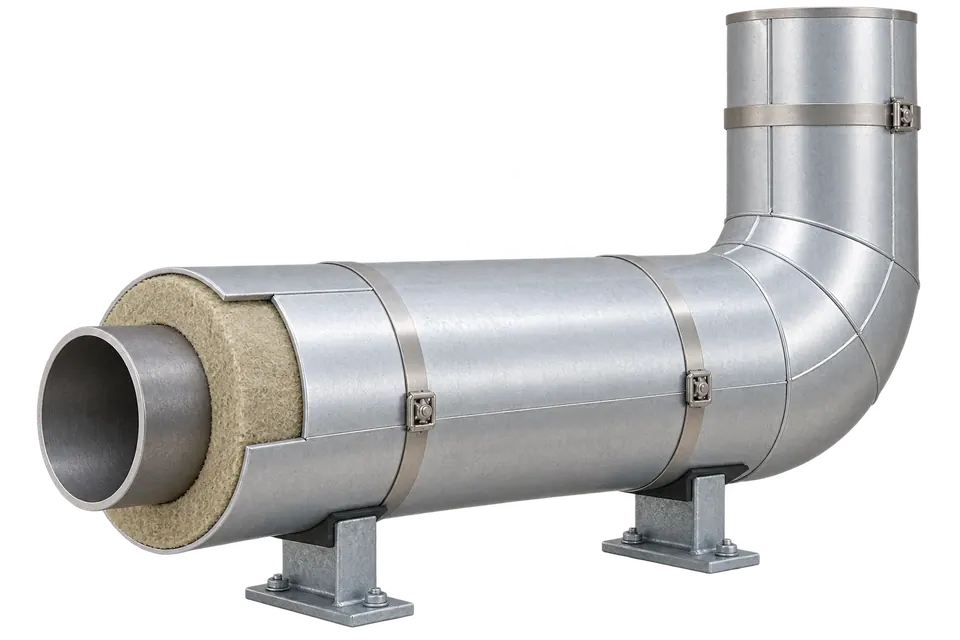
What we insulate
Steam supply and condensate return, hot water and hydronic loops, thermal oil, and hot process lines from 1/2-inch to 12-inch and beyond. Condensate return is the run everyone skips — it is "only" 180 to 212°F, but it is usually the longest pipe in the building and it runs every hour the boiler does.
Fittings, valves and flanges get covered too. A bare 6-inch gate valve loses about as much heat as four to five feet of bare pipe the same size, so where a valve needs service access we sew a removable blanket instead of hard-wrapping it. Outdoor runs get the jacket laps faced away from the weather and sealed, because insulation that takes on water holds it against the steel and corrodes the pipe underneath.
What a bare line actually costs
At 350°F, bare steel loses roughly 780 Btu per hour from every square foot of surface. Two inches of mineral wool cuts that by about 93 percent and puts the jacket surface near 92°F: warm to the touch instead of an injury.
On a real run the numbers get big fast. Two hundred feet of bare 4-inch line at 350°F loses about 184,000 Btu per hour — roughly 1,500 MMBtu a year, about $15,000 at commercial gas rates. The insulation job that stops it prices in the $8,000–14,000 range and pays for itself in well under a year. Our calculator runs the same math on your pipe size, temperature and schedule.
Thickness and material: matched to the temperature
Thickness follows the line temperature: 1.5 inches up to about 200°F, 2 inches to 350°F, 3 inches to 600°F, and 4 inches — sometimes double-layered — above that. Thicker than the rule costs little and keeps paying; thinner leaves fuel on the table and can leave the jacket too hot to touch. The full reasoning is in how thick should steam pipe insulation be.
Fiberglass pipe sections are the workhorse to 850°F. Past that, and anywhere the line has to shrug off abuse, we run mineral wool (to 1,200°F) or calcium silicate; aerogel earns its price where there is no room. Every joint is staggered and sealed — insulation is only as good as its worst gap.
Jacketing that survives a plant
The jacket is what stands between the insulation and the forklift, the weather and the washdown hose. Standard is embossed aluminum, banded and screwed with the laps shedding water; stainless goes where chemicals or washdown demand it, and PVC is the clean, economical choice for indoor mechanical rooms. Gauges and fit-up are on the metal jacketing page.
We roll and cut our own jacketing on our own benches — CJM started as a metal shop, and it shows in the fit. Ells, tees and end caps are cut to the fitting, not bunched foil and tape.
Installed hot, scheduled around you
Pipe insulation is cold work: no welding, no cutting torch, no hot-work permit for most jobs, which means most lines are insulated while they run. The exceptions are tie-ins at equipment and anything that needs a line opened — those we plan into your maintenance window or next shutdown, and we fabricate everything ahead of it so wrench time inside the window is hours, not days.
Every finished run gets ID tags, and you get before-and-after surface temperatures shot with an IR gun — the sheet that shows whoever signs the gas bill exactly what changed.
Quote and planning assumptions
Cost and energy figures on this page are planning examples, not measured results from a CJM project. Material, thickness and installation selections depend on the actual conditions and site requirements.
— What we offer
Molded sections, staggered joints
Pipe sections sized to the line, joints staggered and sealed so the run has no straight-through gap.
Thickness specced to temperature
1.5" to 200°F, 2" to 350°F, 3" to 600°F, 4" beyond — the conservative end of standard practice.
Metal jacket, rolled in-house
Embossed aluminum or stainless, cut on our benches, banded with the laps facing the weather.
Valves and flanges included
Hard covers or sewn removable blankets — a bare valve loses as much as several feet of bare pipe.
Installed with the line hot
Cold work, no hot permit for most jobs. Your line keeps running while we insulate it.
Before-and-after IR readings
Surface temperatures documented on every run, so the savings are visible, not claimed.
Related work from CJM
Tell us what you need and we’ll walk through the options with you. (214) 603-9142
Common questions
What does pipe insulation cost in DFW?
How fast does it pay for itself?
How thick should the insulation be?
Do you have to shut the line down?
In our customers’ words
Get a free walk-down on your piping
Tell us the line size, the temperature and roughly how many feet. Call (214) 603-9142 or run the numbers in the calculator first.
What helps us prepare your quote
- Identify the pipe, tank, equipment or other system and share dimensions or photos when available.
- Include operating temperatures, indoor or outdoor exposure, existing insulation and the required jacket or finish.
- Tell us about access and shutdown windows. We review the application before recommending materials and a scope of work.
— Start your project
Tell us what needs wrapping.
A short form, a walk-down, and a written estimate within 24 hours. No pressure, no obligation.
or call(214) 603-9142Se habla español